Twenty-First Century Skills
In a 2010 article, Education Week defines Twenty-First Century Learning “certain core competencies such as collaboration, digital literacy, critical thinking, and problem-solving that advocates believe schools need to teach to help students thrive” in a modern world. Simply put, the concept of twenty-first century skills in education may best be described as effective learning in today’s classrooms for tomorrow’s world, that is, facilitating what The Partnership for Twenty-First Century Skills refers to as ‘life readiness’. It represents a paradigm shift built upon the concern that in most school settings very little has changed in the learning experience that has been on offer for countless generations.
The slowness of education to adapt to fit an ever-changing world may be attributed to a number of factors: the complex nature of education with so many stakeholders involved; a lack of expertise and sense of fear among practitioners; constantly increasing job pressures and expectations as well as the seemingly fixed nature of traditional methods of assessment. Whatever the reasons may be, the general view is that education as it is in many countries is not providing what industry, or indeed life beyond the school walls demands.
This level of stagnation is in direct opposition to the guiding principle that schooling should prepare learners for the demands of each new century that unfolds. According to The Glossary of Educational Reform, the twenty-first century skills concept is motivated by the belief that teaching students the most relevant, useful, in-demand, and universally applicable skills should be prioritized in today’s schools. Essentially, schools should make it a priority to provide a programme of learning and enrichment that will equip learners with the attitudes, knowledge and skills required to meet the demands of living in a rapidly changing world.
While there is still much debate about what exactly constitutes 21st century skills and the requirements may vary from one school to another, there is common agreement that these are the aptitudes students must develop to help the cope with the requirements of life beyond the classroom, i.e. tertiary education, the world of work and, in general, adulthood. There also seems to be consensus that these skills should be taught and assessed explicitly in academic settings, but also need to be part of the hidden curriculum which is fostered through extra-curricular and community activities.
The Nature of the 21st Century
This begs the question of why is the 21st century so unique; what distinguishes a 21st century existence from that of previous generations? Experts in the field attribute certain key qualities to the 21st century; it is considered to be:
Complex – presenting a range of scientific, political and health challenges
Unpredictable –full of risks but also full of opportunities
Diverse – a much more global, multicultural world than ever before
Dynamic – constantly changing, characterized by new innovations
Knowledge based and information-rich
Technology-driven
Competitive – the need for a more driven approach to innovation
What Skills Are Needed?
The Partnership for Twenty-First Century Skills divides the required competencies into three broad categories:
Learning Skills
- Critical thinking
- Creative thinking
- Collaborating
- Communicating
Literacy Skills
- Information Literacy
- Media Literacy
- Technology Literacy
Life Skills
- Flexibility
- Initiative
- Social Skills
- Productivity
- Leadership
- Global Awareness
- Self-direction
The diagram below, from Alberta’s new Framework for Student Learning illustrates key components of twenty-first century learning:

Learning Skills
Critical and Creative Thinking
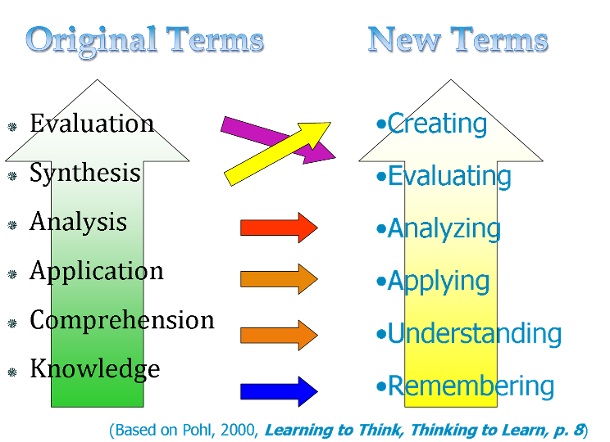
Drawing on advances in cognitive sciences, twenty-first century educators need to nurture in learners the ability not merely to recall information but also to demonstrate higher order skills such as evaluation and synthesis. At the heart of developing this kind of brain-based learning is Bloom’s Taxonomy (see revised diagram below) which shows a direction correlation with the quality of deep learning and brain power which learners in a rapidly changing world will need to master.
Collaborating and Communicating
Like never before, twenty-first centuries must develop an ability to share their ideas effectively and work in partnership with others. In the words of Karen Cator, Director of the Office of Educational Technology, U.S. Department of Education,today’s learners must develop “interpersonal communication skills in order to be successful in an increasingly fluid, interconnected, and complex world”. The expectation here is that our students are part of a global community in which they will find themselves in situations which demand interaction with a wide cross-section of individuals with whom they will have to co-operate in join forces in order to arrive at solutions. Our current education system is failing learnings if they are not placed in problem and project-based scenarios where they can develop these competencies.
Literacy Skills
For the educators of a bygone era, literacy skills would have been limited to the mere arts of reading and writing. However, twenty-first century learning demands the development of various kinds of literacy: information, media and technology. In the modern world where individuals have to navigate through a minefield of ideas from a range of sources, it is crucial that learners acquire the ability to choose their sources appropriately as well as to synthesise and apply the information that is disseminated for a range of purposes.
Life Skills
Perhaps the clearest distinction between Twenty-First Century Learning and that of the education of any subsequent eras is the direct emphasis on preparing learners for the world outside of the classroom. It shifts the focus form a short-sighted approach which dwells on rote learning for the purpose of passing an examination to a much more inter-disciplinary approach which emphasizes the bigger picture and instils the principle of lifelong learning. The skills of adaptability, innovation, productivity leadership and social interaction should all be key components of the twenty-first century classroom with opportunities created to develop and assess these skills on a regular basis.
Challenges to Twenty-First Century Learning
In an article published in the Canadian National Post on Friday November 7, 2014, Moira MacDonald references a a 2013 survey of about 500 Canadian teachers by MindShare Learning, an education technology consulting company which indicated that “a lack of money, up-to-date technology and professional development were the top three barriers to integrating technology into the classroom” in order to facilitate twenty-first century learning.
At a glance some of the twenty-first century skills seem to be in direct opposition to each other. For example, technical literacy and social skills may be viewed by some as being unable to exist. This is where the expertise and skills of twenty-first century educators will be required to provide the riches of learning experiences so that all skills are developed across the relevant disciplines, but none at the expense of the other, thus the need for continuous professional development. It is also crucial to remember that the embedding of twenty-first century skills does not mean ‘throwing out the baby with the bath water” and totally abandoning proven methods. What it requires is the marrying of all the best practices available from differentiation to assessment for learning with modern approaches all aimed at building learning power for tomorrow’s young entrepreneurs and world leaders. Importantly, educators must be guided to explore new tools of assessment such as portfolio building and student-led conferences which can be suitably aligned with twenty-first century learning.
Yet another concern is the readiness of parents, governing bodies and the community to embrace the evolving approaches that are required to prioritise twenty-first century skills. A continuous programme of education and awareness is therefore required as part of any attempt to overhaul current systems.
There is still some controversy concerning twenty-first century with some critics feeling that it is impossible to equip youngsters for a future which it is impossible to conceptualise. It is exactly for this reason that life skills such as adaptability and innovation are crucial as these will prepare learners with the key competences that are needed to be successful regardless of what the day-to-day realities of the twenty-first (and twenty-second) century will be.
DellaValle, Joan & Dotson, Sherrye. Core 21: A Handbook for Teaching the Essential Core Elements for the 21st Century Teacher. 2014
Pohl, Michael. Learning to Think, Thinking to Learn: Models and Strategies to Develop a Classroom Culture of Thinking. Hawker Brownlow Education, 2000
Education Week Teacher PD Sourcebook
http://www.edweek.org/tsb/articles/2010/10/12/01panel.h04.html
The Partnership for 21st Century Learning
Thoughtful Learning
http://www.thoughtfullearning.com/resources/what-are-21st-century-skills
