Best Practices for Education in the 21st Century
Think of the activities and objectives you set for your students. Are there some that you like over others? Is it true that others may produce better results? Do you use certain ones because they are what you have always used, display that knowledge has been memorized, or because they are ones that demonstrate high order thinking? Reflection on your actions, and the reasons for those actions is an integral part to becoming a more effective and efficient educator for the learners in your classroom.
The best teachers are always attempting to solve the same problem; “How do I get my current students to succeed to their fullest potential?” As no two students, nor cohorts of students are alike, this question is always at the forefront of an educator’s mind. We have a problem, question what is needed to answer the problem, predict, experiment, weigh pro & cons and so on, until we come up with the best solution. We use different practices to do so. But are they always the BEST practices?
The Core 21 Model for teaching promotes that anything that works, is a good practice. However, it is only a BEST practice if you continue to reflect and challenge it to become better the next time you use it. The model doesn’t contend that you should do away with activities that are successful in your classroom, but to add to them. The collaborators of the Core 21 model have poured over research in a collaboration of best practices and principals to use for the most effective learning. These standards are based on how the brain engages, learns, retains and retrieves information. “Zemelman et Al, tell what teachers should be doing, brain researchers tell us why they should be doing it.” (Dellavalle/Dotson, 2014)
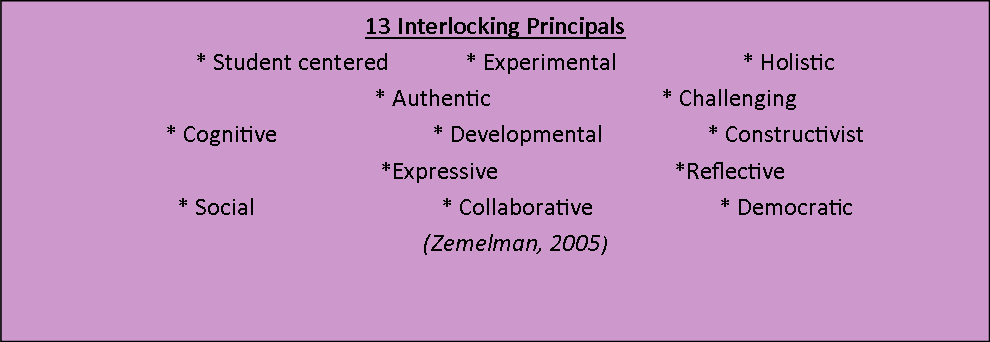
So what are the current “Best Practices” agreed upon most by Core 21 facilitators and researchers? First, they are guided by 13 Interlocking Principals of best practices in students’ learning.
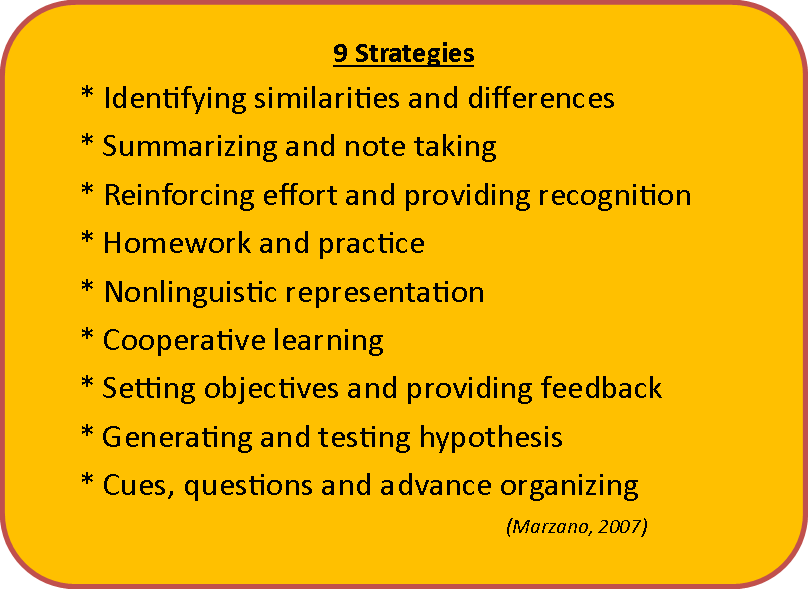
Then, as John Marzano points out in his book, The Art and Science of Teaching (2007), 9 main strategies can be applied using the principles.
“That’s great, but give me some examples of how these create best practices, versus what are no longer accepted as best,” you say? Zemelman et al created a list of “Do More” and “Do Less” in Best Practice (2005). They argue that the former list feeds the brain in nourishing and productive ways, whereas the latter practices are inefficient and often counter-productive.
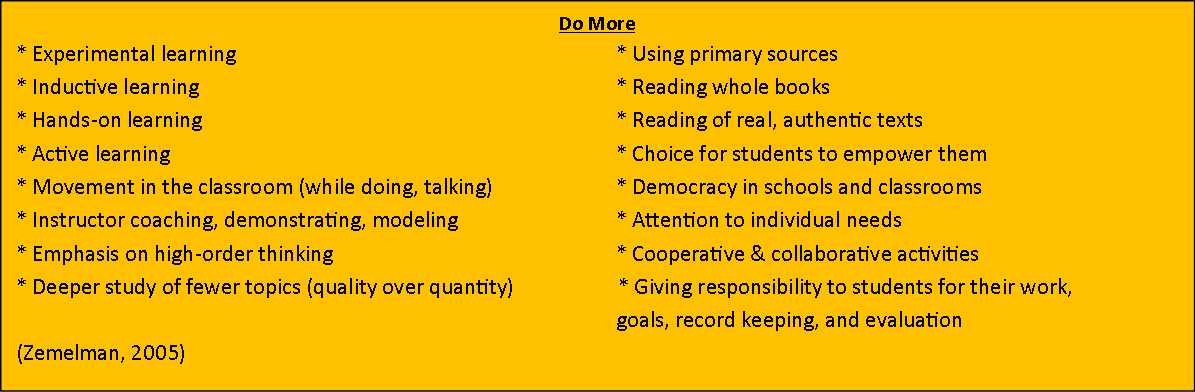
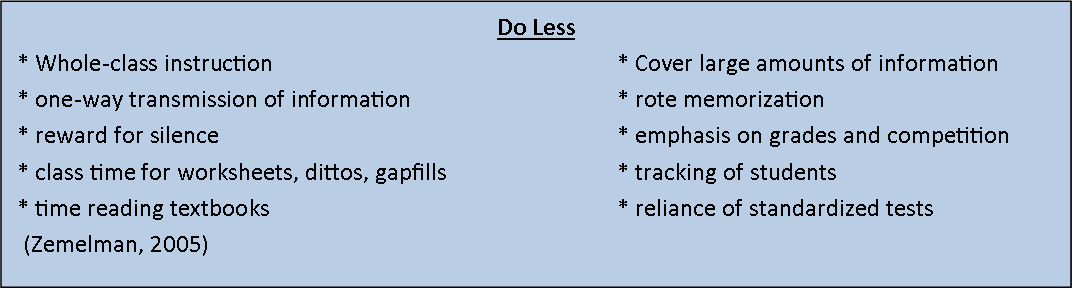
As you can see, you are already doing many practices on the MORE list. However, you are most likely continuing with some inefficient practices on the LESS list. The challenge is to ask yourself what you are doing that doesn’t work, discard it, and substitute it with some of the best practices that you aren’t currently utilizing. In addition, the best practices need to be enhanced and practiced daily in order to keep them effective. The use of best practices will ensure high-order thinking and the use of real world skills.
Which best practices do you use in your classroom? Do they aligh with those of the 21st Century teaching model? Do you agree or disagree with the research of Robert Marzano, Steven Zemelman, Sherrye Dotson, Joan Della Valle and others? Challenge yourself to find out more, using the below resources and to incorporate best practices for the 21st Century of education.
Resources / Bibliography
Books:
Marzano, R.J. (2007). The Art and Science of Teaching. Alexandria, VA: ASCD
Zemelman, S., Daniels, H., & Hyde, A. (2005). Best Practice: Today’s Standards for Teaching and Learning in America’s Schools (3rd ed.). Portsmouth, NH: Heinemann
Dellevalle, J., Dotson, S. (2014). CORE 21: A Handbook for Teaching the Essential Core Elements for the 21st Centruy Teacher. (In final edit stage, To be published)
Videos:
Teaching in the 21st Century, Dellatoss, S. [Video file]. Retrieved from
http://www.youtube.com/watch?v=075aWDdZUlM
Singapore's 21st-Century Teaching Strategies, Education Everywhere [Video file]. Retrieved from
http://www.youtube.com/watch?v=M_pIK7ghGw4
When I Want to Become a Teacher (Part 1) [Video file]. Retrieved from
http://www.youtube.com/watch?v=w3PhJDxvgJM&index=8&list=PL1FE75261C73BA4F3
When I Want to Become a Teacher – Remix (Part 2) [Video file]. Retrieved from
http://www.youtube.com/watch?v=a7-QIZnCD2Y&list=PL1FE75261C73BA4F3&index=7
Teaching Strategies – LearningStyles, Heritage College [Video file]. Retrieved from
http://www.youtube.com/watch?v=oNxCporOofo here
Websites:
Lenz, B. (2014, October 23). New Evidence: Deeper Learning Improves Student Outcomes. Edutopia. Retrieved from:
http://www.edutopia.org/blog/new-evidence-deeper-learning-improves-student-outcomes-bob-lenz
