Eric Jensen, in another book, Brain-Based Learning, describes Brain-Based Education as “the purposeful engagement of strategies that apply to how our brain works in the context of education.” He further elaborated that it was “the engagement of strategies based on how the brain works…..it is the professionalism of knowing why one strategy is used over another.”The Glossary of Educational Reform, an online database of educational terms, drills further and provides a separate definition of Brain-based Learning as “the application of teaching methods, lesson designs, and school programs that are based on the latest scientific research about how the brain learns including factors such as cognitive development recognizing how students learn differently as they age, grow, and mature socially, emotionally, and cognitively.”
It is no wonder that Dotson et al, suggests that one of the key questions an educator must ponder, is “ what strategies will I use that ensure student engagement through use of brain based practices?” In the book, Teaching with the Brain in Mind, Eric Jensen concluded that “human beings have the capacity and choice to be able to change our brains”. Jensen’s conclusion came from translating extensive research findings in neuroscience which has had profound implications for pedagogy. Two key terms that had indisputable ramifications on how the brain is now perceived and are transferable to pedagogy were neuroplasticity and neurogenesis.
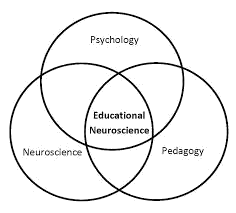
The Encyclopedia Britannica, defines neuroplasticity as the “capacity of neurons and neural networks in the brain to change their connections and behavior in response to new information, sensory stimulation, development, damage, or dysfunction.” The Journal of Neuroscience, defines Neurogenesis “as the ability of the adult nervous system to generate new neurons.” Therefore, a focus in education on the brains capability to both change connections as well as its ability to generate new neurons, should be the Eureka moment for education. Since such a discovery put into practice should reap infinite benefits.
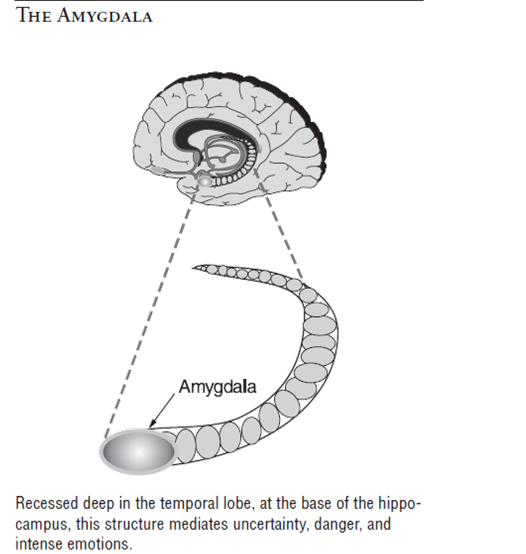
As a greater understanding of the brain emerged, and clearer mapping of its parts and their specific functions were agreed, one section that was considered to be important in the educative process was the Amygdala. The Amygdala, according to Gray’s Anatomy, a textbook used in anatomy lessons, are almond-shaped groups of nuclei located deep and centrally within the temporal lobes. It is shown in research to perform a primary role in the processing of memory, decision-making and emotional reactions. Interestingly, this one part of the brain is primarily involved in processes that are critical to education objectives and this has implications on the priority of data driven functions. The effects are profound since learner engagement, could be determined by how the amygdala perceives an environment.
Therefore depending on how a situation is assessed, learning can be enhanced or hindered. Maslow’s hierarchy of needs covers this in its first three levels, albeit from a psychological viewpoint.
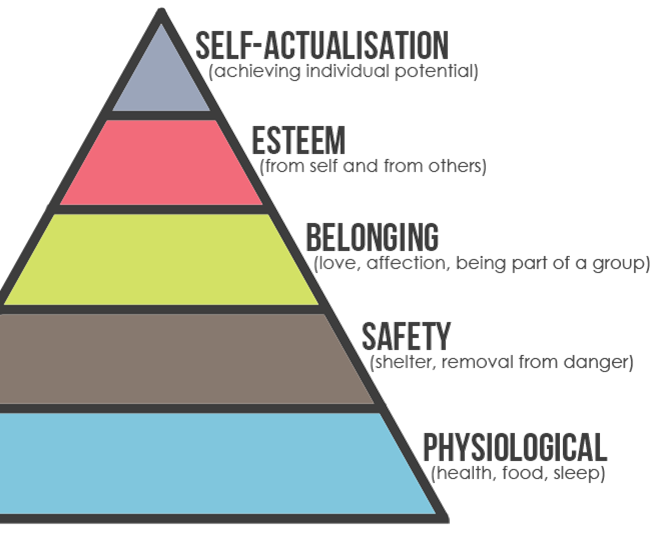
In a similar model, David Sousa, in his book, How the Brain Learns, further expanded the idea with a neurological slant. According to Sousa, there are three levels of ‘Data In’, a phrase he coined to describe the information transfer in the brain.

Naturally, survival information is of utmost priority of data processing, while the emotional connections to data follow next in the process. Data for learning is of the lowest priority, when the brain decides to store information! Here lies a fundamental barrier in the learning process. Learning in general is targeted at the higher level, however, it is perceived by the amygdala as of the lowest priority. This finding underpins the importance of engagement in the learning process, since by making emotional connections to the information presented, we can shift data that was designed solely for the purposes of learning from the learning priority area into the emotions area, thereby increasing the potential for information to be stored more rapidly and permanently. It is what the salesmen call the “buy-in”! The table below taken from Jensen's book, shows the strong connections between the strength of memory and the intensity of emotions.
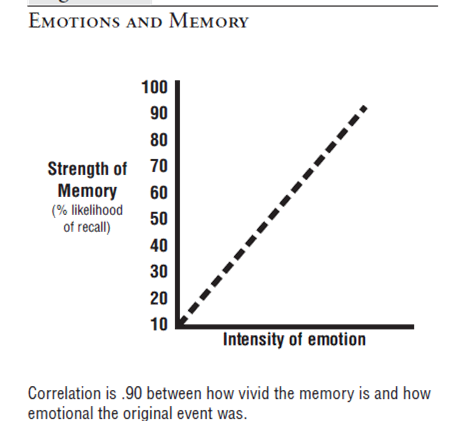
As Dotson et al puts it, “Our ultimate goal in the 21st century is to have students solve real world problems and to connect information to themselves and to others around them. ….they can’t do this if they are not emotionally connected in some way with the work.” This understanding is critical to everyone involved in education.
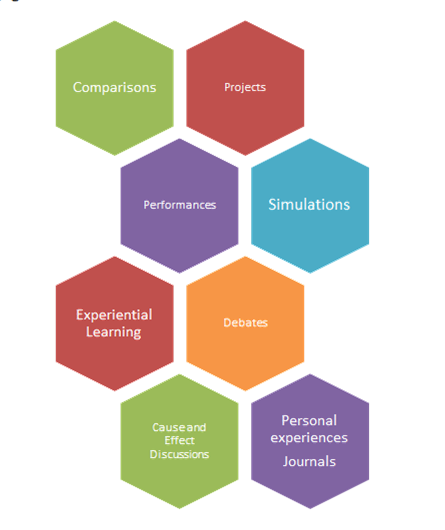
Brain-based education is a large, complex and at times controversial field, since the ideas that the strategies are based on sometimes rely on inconclusive research that are in some cases still challenged by some neuroscientists if not in veracity but by the extent of it. However, it is undeniable that the brain responds whether through neuroplasticity or neurogenesis when the required stimuli are present. It is vital that educators are fully cognizant of the strategies that will increase engagement. Below is a list of strategies that can help in the process.
Jensen et al, agree on ten key principles of Brain Based learning and also suggest practical applications in the classroom. These key principles focus on the big picture rather simple mechanical applications as in how to give directions to maximize it being carried out. The table below summarizes these tenets upon which a Brain Based education should be founded.
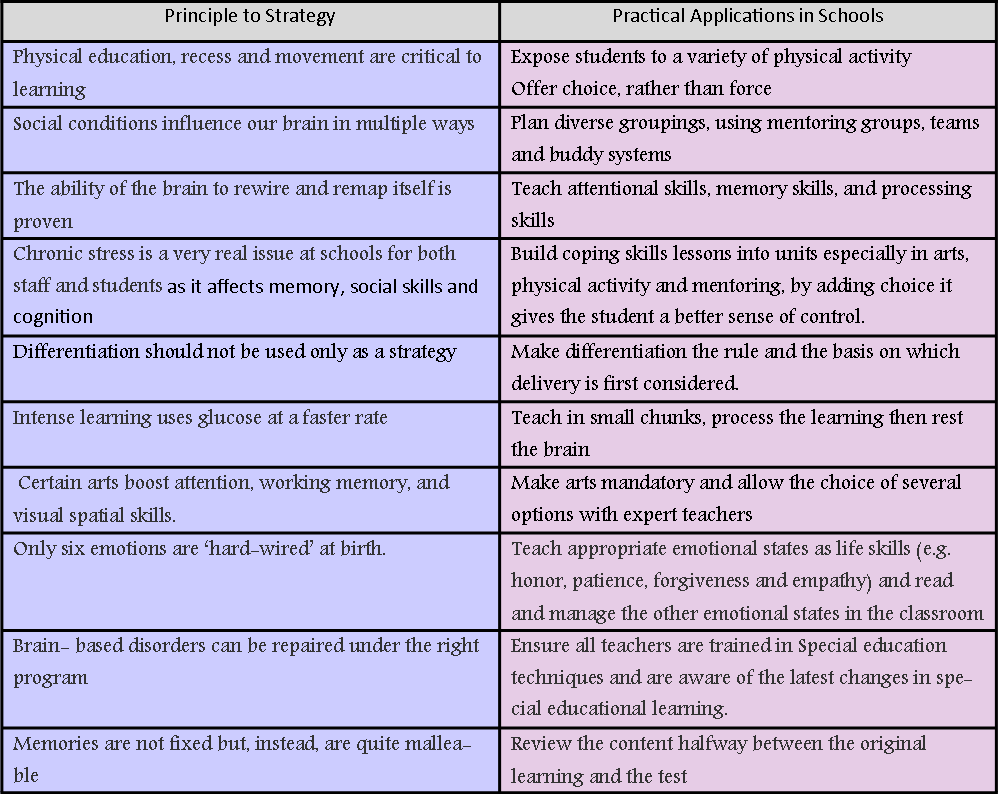
Many researches have been conducted that focus on one or more of the principles described above. The application of these successfully in the classroom relies heavily on the perma-residual effects on the brains neurons after completing certain activities. Some examples that have produced rich information for educators are:
-
The effect of Music on the Brain and its impact on learning
-
The effect of Physical exercise on the brain and its impact on learning
-
The effects of Nutrition on the brain and its impact on learning
-
The effects of memory techniques on learning
-
The effect of the Arts on learning
-
The effects of social factors on the brain
In conclusion, with the vast amount of data explaining the workings of the brain it would be criminal for educators to ignore it. The impact that this vital cog has in the learning process should compel educational architects to create plans with the brain as the ultimate focus. Designing learning experiences that engage learners will have long-term effects on the ability of the learner to recall and analyze and in effect create permanent neurological connections in the brain.

|
The Brain and Learning.pdf Size : 333.609 Kb Type : pdf |
