Differentiation
The world of education has undergone vast change in its methodology and instruction as it hurtles into 21st century. It is indeed difficult to visualize schooling just a century back with Dickensonian tales describing to some macabre detail, the factory like condition of schooling. A marked shift from one size fits all to a system which recognizes differences in each learner and facilitates development to maximize potential by adopting differentiated mode of educational instruction. This has been facilitated by increased exposure to global diversity and necessity to collaborate on solving many 21st century issues and problems. Watch https://www.youtube.com/watch?v=zDZFcDGpL4U
Education today recognises each student as a unique individual and has veered from being teacher centric to learner centric. The root word of differentiation arises from difference. Differences in gender, behavior, culture, interest all work towards making an individual distinctly unique. When our left-brain is distinctly different from right, and operates at different levels for each of these unique individuals, it is difficult to think how a student can actually benefit from a set uniform linear mode of learning that was adopted by most schools.
Differentiated instruction is a teaching methodology which caters to uniqueness of each individual and ensures that all students are exposed to relevant learning opportunities and subsequent feedback tailored to their individual needs. This approach does not cater to an individual only but uses multiple classroom instructions and assessment strategies to ensure that each students learning needs are met.
Tomlinson who has done much work on differentiation, defines it as
‘an approach to teaching in which teachers proactively modify curricula, teaching methods, resources, learning activities, and student products to address the diverse needs of individual students and small groups of students to maximize the learning opportunity for each student in a classroom.’
(Bearne, 1996; Tomlinson, 1999, in Tomlinson, 2003)
DI is grounded on eight core principles (Tomlinson, 2000):
- Teachers focus on the essential concepts and skills.
- Teachers understand, appreciate, and build upon student differences.
- Assessment and instruction are inseparable.
- Teachers adjust content, process, and products in response to students’ readiness, interests and learning profiles based on Howard Gardners Theory of Multiple intelligence.
- All students participate in respectful work.
- Teachers and students are collaborators in learning.
- Goals in a differentiated classroom are for maximum growth and individual success.
- Flexibility is the hallmark of a differentiated classroom
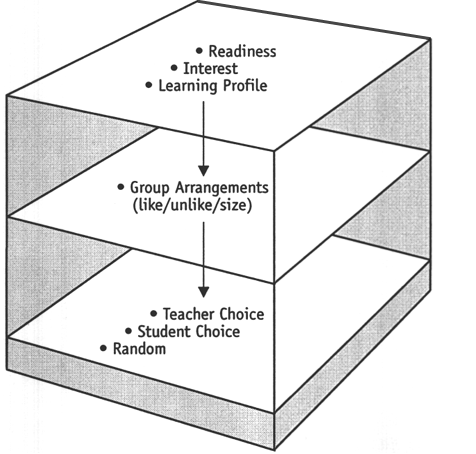
Fig 1- Flexible grouping options (Carol Ann Tomlinson and Susan Demirsky Allan: Leadership for Differentiating Schools & Classrooms)
To cater to these core principles it is well worth identifying the role that an educator or facilitator has to play to achieve maximum outcome or growth in student learning.
- being proactive rather than reactive
- making flexible use of small teaching-learning groups in the classroom
- varying the materials used by individuals and small groups
- using variable pacing to address learner needs
- being knowledge centred [ie the imparting of knowledge]
- being learner centred
- applying the concept of tiered lesson in the classroom
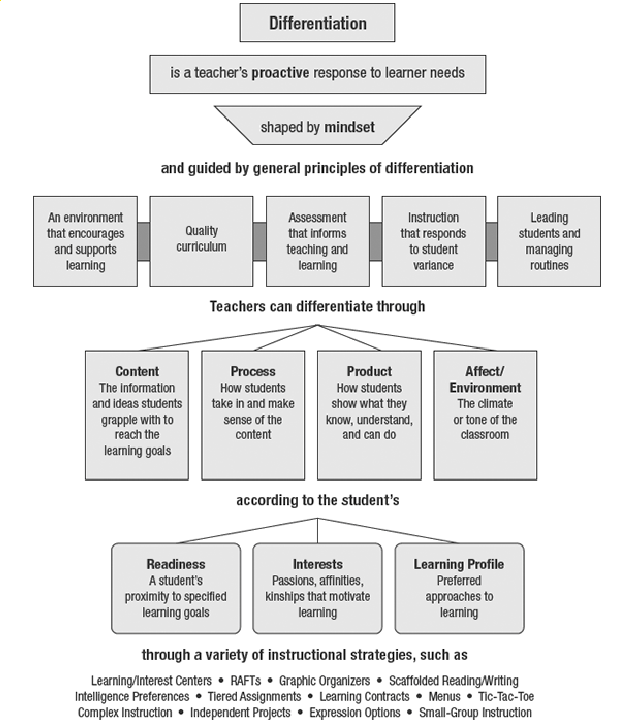
Delavalle and Dotson (pg129)
Implementing Differentiation in our classrooms ( From Carol Ann Tomlinson and Susan Demirsky Allan: Leadership for Differentiating Schools & Classrooms)
Content. A teacher can differentiate content. Content consists of facts, concepts, generalizations or principles, attitudes, and skills related to the subject, as well as materials that represent those elements. Some of the ways a teacher might differentiate access to content include
- Using math manipulatives with some, but not all, learners to help students understand a new idea.
- Using texts or novels at more than one reading level.
- Presenting information through both whole-to-part and part-to-whole approaches.
- Using a variety of reading-buddy arrangements to support and challenge students working with text materials.
- Reteaching students who need another demonstration, or exempting students who already demonstrate mastery from reading a chapter or from sitting through a reteaching session.
- Using texts, computer programs, tape recorders, and videos as a way of conveying key concepts to varied learners.
Process. A teacher can differentiate process. Process is how the learner comes to make sense of, understand, and “own” the key facts, concepts, generalizations, and skills of the subject. A familiar synonym for process is activity. A teacher can differentiate an activity or process by,
- Providing varied options at differing levels of difficulty or based on differing student interests.
- Offering different amounts of teacher and student support for a task.
- Giving students choices about how they express what they learn during a research exercise—providing options, for example, of creating a political cartoon, writing a letter to the editor, or making a diagram as a way of expressing what they understand about a particular concept
Product. A teacher can also differentiate products. We use the term products to refer to the items a student can use to demonstrate what he or she has come to know, understand, and be able to do as the result of an extended period of study. Among the ways to differentiate products are to:
- Allow students to help design products around essential learning goals.
- Encourage students to express what they have learned in varied ways.
- Allow for varied working arrangements (for example, working alone or as part of a team to complete the product).
- Provide or encourage use of varied types of resources in preparing products.
- Provide product assignments at varying degrees of difficulty to match student readiness.
- Use a wide variety of kinds of assessments.
- Work with students to develop rubrics of quality that allow for demonstration of both whole-class and individual goals.
Student Characteristics for Which Teachers Can Differentiate( From Carol Ann Tomlinson and Susan Demirsky Allan: Leadership for Differentiating Schools & Classrooms)
Students vary in at least three ways that make modifying instruction a wise strategy for teachers: Students differ (1) in their readiness to work with a particular idea or skill at a given time, (2) in pursuits or topics that they find interesting, and (3) in learning profiles that may be shaped by gender, culture, learning style, or intelligence preference.
Readiness. To differentiate in response to student readiness, a teacher constructs tasks or provides learning choices at different levels of difficulty. Some ways in which teachers can adjust for readiness include
- Adjusting the degree of difficulty of a task to provide an appropriate level of challenge.
- Adding or removing teacher or peer coaching, use of manipulatives, or presence or absence of models for a task. Teacher and peer coaching are known as scaffolding because they provide a framework or a structure that supports student thought and work.
- Making the task more or less familiar based on the proficiency of the learner's experiences or skills for the task.
- Varying direct instruction by small-group need.
Interest. To differentiate in response to student interest, a teacher aligns key skills and material for understanding from a curriculum segment with topics or pursuits that intrigue students. For example, a student can learn much about a culture or time period by carefully analyzing its music. A social studies teacher may encourage one student to begin exploring the history, beliefs, and customs of medieval Europe by examining the music of the time. A study of science in the Middle Ages might engage another student more. Some ways in which teachers can differentiate in response to student interest include
- Using adults or peers with prior knowledge to serve as mentors in an area of shared interest.
- Providing a variety of avenues for student exploration of a topic or expression of learning.
- Providing broad access to a wide range of materials and technologies.
- Giving students a choice of tasks and products, including student-designed options.
- Encouraging investigation or application of key concepts and principles in student interest areas.
Learning Profile. To differentiate in response to student learning profile, a teacher addresses learning styles, student talent, or intelligence profiles. Some ways in which teachers can differentiate in response to student learning profile include
- Creating a learning environment with flexible spaces and learning options.
- Presenting information through auditory, visual, and kinesthetic modes.
- Encouraging students to explore information and ideas through auditory, visual, and kinesthetic modes.
- Allowing students to work alone or with peers.
- Ensuring a choice of competitive, cooperative, and independent learning experiences.
- Balancing varied perspectives on an issue or topic.
- Providing authentic learning opportunities in various intelligence or talent areas.
As you can see, differentiation of content, process, and products is achievable in each of the areas of student readiness, interest, and learning profile.
Instructional Strategies That Facilitate Differentiation( From Carol Ann Tomlinson and Susan Demirsky Allan: Leadership for Differentiating Schools & Classrooms)
Instructional strategies are tools of the teacher's art. A teacher who is comfortable and skilled with the use of multiple instructional strategies is more likely to reach out effectively to varied students than is the teacher who uses a single approach to teaching and learning. Teachers are particularly limited when the sole or primary instructional strategy is teacher-centered (such as lecture), or drill-and-practice (such as worksheets).
Numerous instructional strategies invite attention to student readiness, interest, and learning profile. Among these strategies are learning centers, interest groups, group investigation, complex instruction, compacting, learning contracts, tiered activities, tiered products, rubrics constructed jointly by teacher and student, use of alternative forms of assessment, to name a few.
Differentiated instruction is linked to Brain based research. Student learning is facilitated in a rather dramatic manner as it provides a more emotionally conducive yet flexible atmosphere for the child to thrive in and actualize his potential.When the readiness or interest level of student to engage in learning is high
- a student feels safe and learning is more impactful
- a student is able to make sense and meaning of the information if pacing is appropriate
- long term retention of concepts is possible
- using higher levels of thinking and learning ensures cementing of learning
We must continue to change CLASSROOMS to meet the needs of students, rather than change STUDENTS to meet the needs of our classrooms.
Schools are required to accommodate students, not accommodate who they would like them to be.
Teachers are required to teach all students, not just the easy ones.
Resources
Books DellaValle, J. and Dotson, S., Core 21: A handbook for teaching the essential core elements for the 21st century teacher.
Carol Ann Tomlinson and Susan Demirsky Allan: Leadership for Differentiating Schools & Classrooms
Websites
Videos
RSA Animate - Changing Education Paradigms https://www.youtube.com/watch?v=zDZFcDGpL4U
Inclusion and Differentiated Instruction: Teachers in the Movies do it Too http://www.youtube.com/watch?v=i6rEy3Lqfio
An Excerpt From a Visit to a Differentiated Classroom http://www.youtube.com/watch?v=SaGgUsMqNPA
Differentiation with real-world perspectives
|

