Rigor and Relevance in the Classroom
Challenging and meaningful lessons to promote higher level thinking
Including Blooms Taxonomy, Best Practices, brain based strategies, differentiation, problem based learning while incorporating 21st century skills will result in higher standards and deeper personal connections to the lessons being taught in the classroom. According to Dr. Willard Daggett, the founder of the International Center for Leadership in Education when addressing the Regional Chamber of Commerce in Conton Ohio, “relevance makes rigor possible for most students”. (Building Stark By Degrees, 2010)
In order for student engagement, higher level thinking must be at the core of every lesson. Teachers can look the Rigor and Relevance framework while writing their lesson plans and feel confident that they are facilitating 21st century learning.
The framework was created by the International Center for Leadership in Education with the aim of combining content knowledge and application of the knowledge in a meaningful way. As Joan DellaValle and Sherrye Dotson emphasize in A handbook for Teaching the Essential core Elements for the 21st Century Teacher, “ Students must be able solve problems using higher-level critical thinking skills and those problems must have real application, not fabricated situations that apply to the classroom only”(p.163).
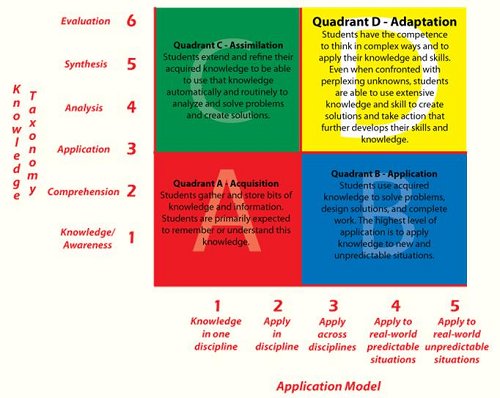
The framework teachers can use to ensure their lessons apply to real work problems is seen below with four quadrants that apply a combination of higher levels of thinking with higher levels of understanding. The application of Blooms Taxonomy; formally known as Knowledge Taxonomy within and across disciplines can indicate whether a child is thinking and learning with rigor and relevance. This framework moves “…from the acquisition of information to the application of information across disciplines” (DellaValle & Dotson, 164). When planning lessons, teachers should aim for students to work within quadrant C and D in order to be prepared for real world application of their knowledge.
Watch Dr Willard Daggett, the founder and Chairman of the International Center for Leadership in Education explain why and how this framework must be applied to classroom learning.
