Problem Based Learning (PBL)
What is Problem Based Learning (PBL)?
Problem Based Learning (PBL), sometimes known as inquiry based learning, is when students are presented with a problem to which they have to find a solution. To be more specific, in problem based learning ‘a real world problem is presented to the class through an entry document, video, speaker, field trip or any other highly engaging activity’ (Dellavalle and Dotson, p. 71) and the students then work towards finding a solution to the problem.
Why should we use this method?
There are times when we, as teachers, feel that our students are not fully engaged in our lesson – they might be yawning, looking at the clock or just, generally, not participating. Take a moment to think about why this could be happening - maybe it’s because we, the teachers, are talking too much and not basing our lesson around the needs of our students. This could also mean that the activities that we are giving our students are not providing them with an opportunity to use higher order thinking skills and so they are starting to become bored. Therefore, as seen in the revised version of Bloom’s taxonomy below, our teaching and learning environments may be limiting our students to the skills of remembering and understanding and not challenging them any further:
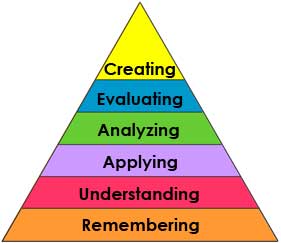
Revised version of Bloom’s taxonomy taken from: http://ww2.odu.edu/educ/roverbau/Bloom/blooms_taxonomy.htm
We are in the 21st century and, with the advent of the internet, information and facts are easily available and therefore no longer have the same value as they did in the past. Therefore, ‘…we must provide opportunities for engaged learning rather than simply give information to learn or memorize’(DellaValle and Dotson, p. 52).In order to provide opportunities for engaged learning, we need to focus on the skills that students do need to develop and have for life in the 21st century and introducing PBL into your classroom can help to do this.
The main question that students need to ask themselves when faced with a PBL activity is ‘what do [I] need to know in order to find a solution to this problem’ and this kind of activity then ‘requires active engagement by all learners.’ (DellaValle and Dotson, p.71-72)
During PBL activities, students usually work in small groups to find a solution to a problem and this encourages the skills of communication and collaboration as well as other skills such as researching, surveying, examining, inquiring, analyzing and evaluating a problem (DellaValle and Dotson, p. 72). Students are expected to present their solutions at the end and this again means that students need to work on the skills of communication and collaboration.
PBL activities require students to use higher order thinking skills such as analyzing and evaluating because, right from the start of the activity, students need to think carefully in order to ask the right questions to solve the problem. We, as teachers, do not need to provide our students with those questions, we need to let them figure those questions out for themselves in order to give them an opportunity to become independent learners, thinking for themselves.
So, why should we use PBL in the classroom? Essentially, because PBL ‘changes the environment of the classroom from one of ‘sit and get’ where students can zone out to one where they are in a positive brain based state of active engagement’. (DellaValle and Dotson, p. 81)
Applying PBL in the classroom
Now we know what PBL is and why it should be used but we may still be at a loss as to how to start using this in the classroom. Firstly, take a look at the table below which focuses on some of the content discussed above and make a point of focusing on the ‘how’ column in order to gain confidence on using PBL in the classroom:
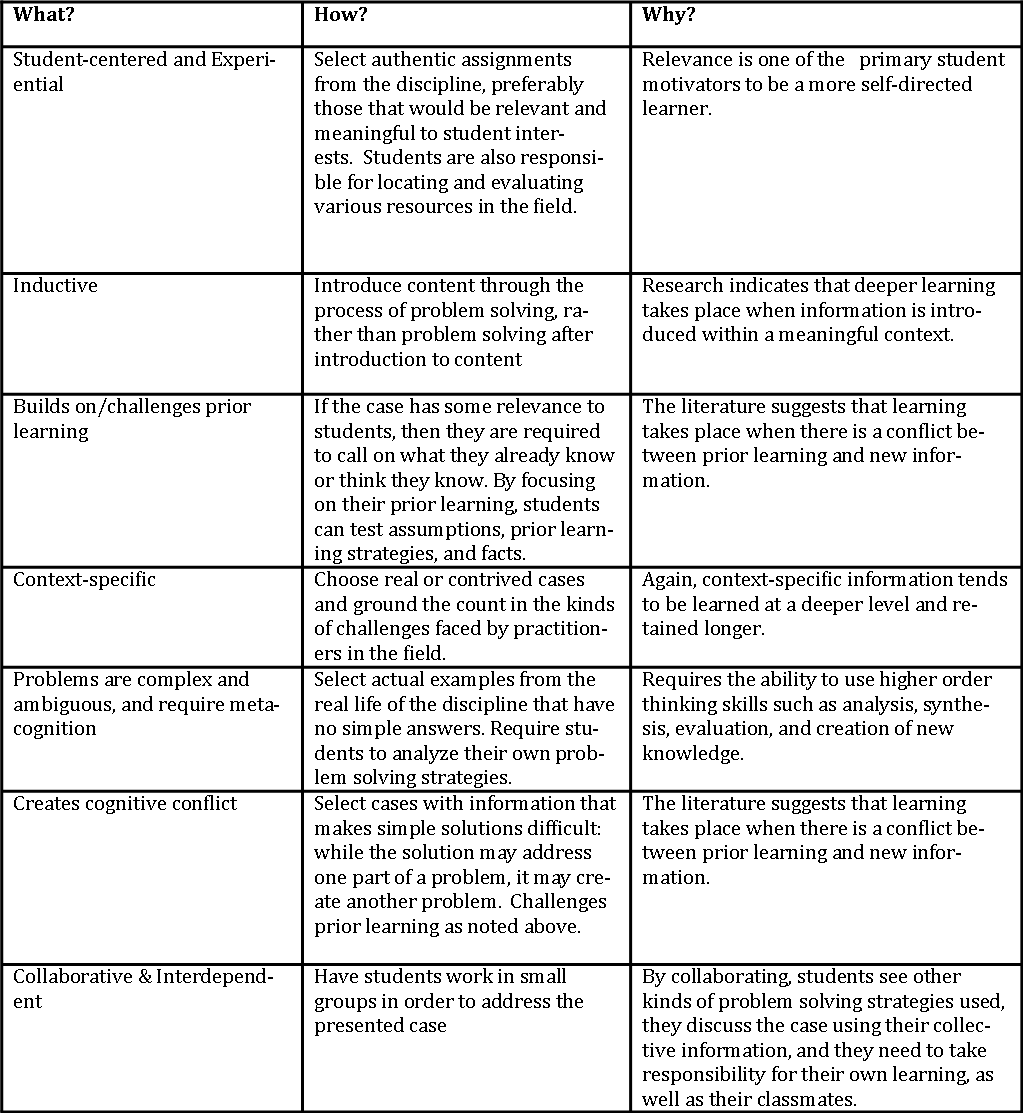
Table taken from: http://www.pbl.uci.edu/whatispbl.html
Now, to further clarify your understanding on how to introduce PBL in the classroom, watch the two videos below to see how one teacher introduced PBL to some students and then their reaction to the PBL experience:
Finally, it’s also important to understand that PBL can be used in primary school classrooms as well as secondary school classrooms. The approach may be slightly different and possibly a bit more guided than PBL activities in secondary school but it still is possible. Take a look at the video below to see an example of PBL in action in a primary school classroom:
Problem Based Learning: Mr Rodriguez’s Class: | Now, watch the video below to hear teachers, students and parents reactions to PBL activities in primary school: |
Conclusion
In conclusion, PBL is a method worth trying out in your classroom to fully engage your students and encourage them to use higher order thinking skills. So, go ahead and give it a go in your classroom today, there’s no reason not to!
Bibliography
Books
DellaValle, J. and Dotson, S., (unpublished) Core 21: A handbook for teaching the essential core elements for the 21st century teacher.
Websites
Dr De Gallow, What is problem based learning?, Retrieved 7 November 2014 from: http://www.pbl.uci.edu/whatispbl.html
Overbaugh, Richard C. and Schultz, Lynn, Bloom’s taxonomy [Online image],Retrieved 7 November 2014 from: http://ww2.odu.edu/educ/roverbau/Bloom/blooms_taxonomy.htm
Engaging students with Problem Based Learning, Part 1 (2014, January) [Video file],Retrieved 8 November 2014 from: http://www.youtube.com/watch?v=VSAkRBxMR9A, Published online by NEBHE PBL Projects.
Engaging students with Problem Based Learning, Part 2 (2014, January) [Video file], Retrieved 8 November 2014 from: http://www.youtube.com/watch?v=3nYX4UgaBM4 , Published online by NEBHE PBL Projects.
Project/Problem based learning in Elementary School (2012, August) [Video file], Retrieved 8 November 2014 from: http://www.youtube.com/watch?v=PlDplQipLwc , Published online by KiCubed.
Rodriguez, Rodrigo (2014, June), Problem Based Learning: Mr Rodriguez’s Class [Video file], Retrieved 8 November 2014 from: http://www.youtube.com/watch?v=2YRPAEKL6GE

|
Problem Based Learning.docx Size : 34.645 Kb Type : docx |

|
Problem Based Learning.pdf Size : 433.226 Kb Type : pdf |
